Market newsAffordability

How much home loan can I get on a R30 000 salary in South Africa?

Short answer: about R 886 500. On a R 30 000 gross salary, the banks' 30% rule gives a R 9 000 maximum instalment, which supports roughly a R 886 500 bond at today's 10.75% prime over 20 years. bond.co.za works through the rate, debt and deposit scenarios.

By Neil B · Checked against published primary sources · Published 2026-11-14 · Last verified 2026-11-14

affordabilitysalary-to-bondfirst-time-buyerbond-qualificationnovember-2026
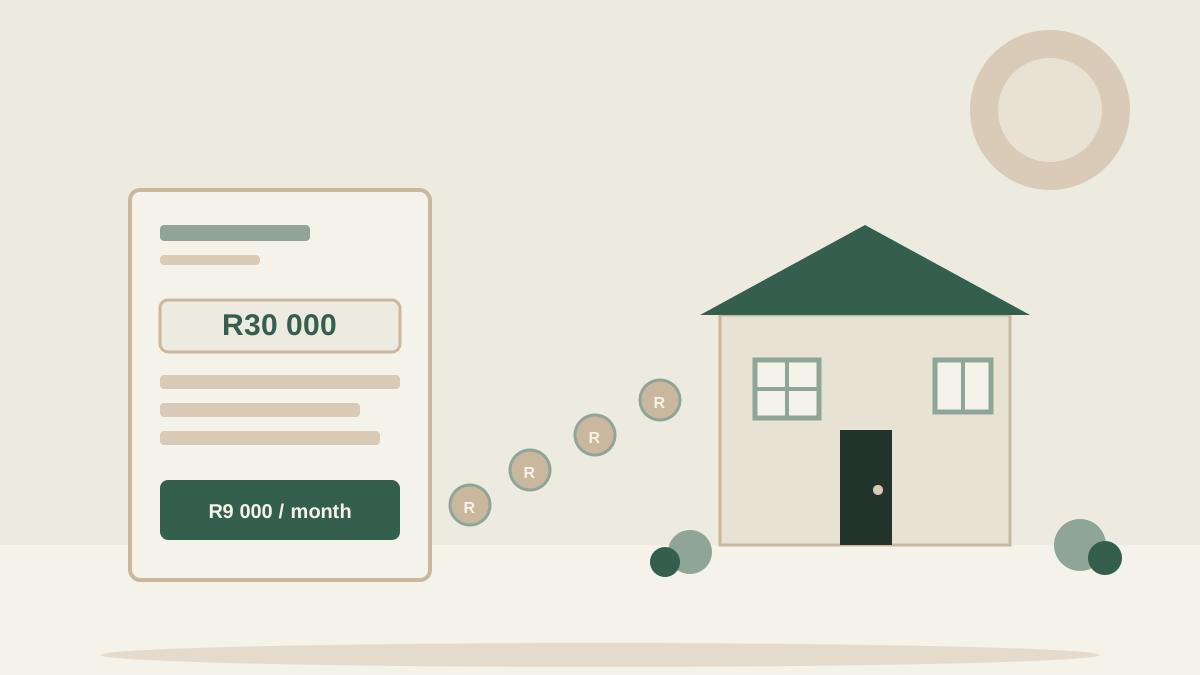
Illustration of a payslip marked R30 000 with coins flowing from it toward a house sized to match, on a cream background

Key takeaways

  • 01On a R 30 000 gross salary, banks' 30% rule caps your instalment at R 9 000 a month — the National Credit Act affordability yardstick every bank applies.
  • 02At today's 10.75% prime (SARB, effective 25 September 2026), R 9 000 a month over 20 years supports a bond of about R 886 500 — bond.co.za's calculation, not an offer.
  • 03Your rate moves that number sharply: between R 780 023 at a weak-profile 12.75% and R 948 850 at a strong-profile 9.75%.
  • 04Existing debt is the biggest single lever: a R 1 500 car instalment cuts the bond to about R 738 750.

How much home loan do I qualify for on R30 000 a month?

About R 886 500 at 10.75% prime — and anywhere from R 780 023 to R 948 850 depending on the rate you are offered. Banks size your bond from the instalment you can carry, not from the salary itself: under the affordability rules of the National Credit Act, the instalment should stay near 30% of your gross monthly income. On R 30 000 gross, that is a R 9 000 maximum instalment. The table below converts that instalment into a bond at the rates actually on the panel; our full home loan on a R30 000 salary guide covers the deposit, existing-debt and term trade-offs behind the numbers.

Maximum bond supported by a R 9 000 monthly instalment (R 30 000 gross salary, 30% rule), 20-year term — computed by bond.co.za at render time from the rate range on our bank panel. Illustration, not a quote; your offered rate may differ.
Offered rateMonthly instalmentBond you can carry
Prime plus 2% (12.75%) — weakest profileR 9 000R 780 023
Prime (10.75%) — standard reference rateR 9 000R 886 500
Prime minus 0.67% (10.08%) — average negotiated concessionR 9 000R 927 521
Prime minus 1% (9.75%) — strongest profileR 9 000R 948 850

The spread is worth R 168 826 of buying power — the same salary, the same instalment, purely the rate. That is why it pays to have every bank on the panel compete: the average negotiated concession is currently 0.67% below prime, which lifts the bond to about R 927 521. Stretching to a 25-year term adds a little more room — roughly R 935 461 — but you pay noticeably more interest over the life of the loan. Run your own numbers in the home loan affordability calculator.

How does a car loan or credit card change what I qualify for?

Directly and rationally: every rand of existing monthly debt repayments comes off the R 9 000 first. Banks net your car finance, credit-card minimums and personal loans off the 30% instalment headroom before sizing the bond — so a R 1 500 car instalment leaves R 7 500, which supports about R 738 750 at prime. That is R 147 750 less house for the same salary.

Bond capacity on a R 30 000 gross salary at 10.75% prime, 20-year term, after existing monthly debt repayments — computed by bond.co.za at render time.
Existing monthly debtInstalment headroomBond you can carry
NoneR 9 000R 886 500
R 1 500R 7 500R 738 750
R 2 500R 6 500R 640 250

The two numbers that move your answer are the same two Google's AI Overview asks about: your other monthly debt and your deposit. Tell us yours and we'll put a rand figure on your bond below.

What difference does a deposit make on a R30 000 salary?

A deposit does not change the bond you qualify for — the R 9 000 headroom is set by your income and debt. It changes the price of the house that bond covers: save a 10% deposit and the same R 9 000 instalment reaches a ~R 984 999 purchase instead of R 886 500. A bigger deposit also typically earns a better rate, and buyers with deposits are declined far less often. For benchmarks, see our deposit guide.

What do banks check besides your salary?

Three things, and any of them can size the bond down. First, your credit record: the score decides whether you qualify at all and drives the margin over prime you are offered — the panel in our table spans prime minus 1% to prime plus 2%. Second, a full affordability assessment under the NCA: the bank documents your actual living expenses, not just the 30% rule, and discretionary spending counts. Third, the property itself: the bank values it independently and lends against that valuation, not the asking price. None of these checks is a reason not to apply — but gross salary alone is never the whole answer, which is why every figure above is an illustration rather than an offer. Get pre-qualified and you'll know where you actually stand before you shop.

Could the 19 November 2026 MPC decision change this?

Only through the rate column. The SARB's next decision lands 19 November 2026, with repo at 7.25% and prime at 10.75% (effective 25 September 2026) going in. A 25 bp cut would lift the R 9 000 instalment to a bond of about R 901 460 — roughly R 14 961 more buying power. A hold changes nothing: the maths above simply stays true. We model both outcomes in our November MPC preview, and for the full salary-to-bond method see our how much home loan can I get guide.

(Published 14 November 2026. Prime and repo verified against the SARB September 2026 MPC statement; the 30% affordability rule per standard bank practice. Repayment and bond capacity examples: 20-year term at the stated rates — your actual rate may differ.)

Get your free Bond Readiness Report

A personalised affordability range, a realistic rate band, estimated total upfront costs and the document checklist for your situation. We’ll open a request in your email client, ready to send.

Estimate only · No spam calls · Unsubscribe at any time.

Free to use. bond.co.za is an independent educational resource — we do not provide credit, origination, legal or conveyancing services. About our independence.

Frequently asked questions

How much home loan can I get on a R25 000 salary?

Apply the same 30% rule: a R25 000 gross salary gives a R7 500 maximum instalment, which supports a bond of about R 738 750 at 10.75% prime over 20 years (bond.co.za calculation). Existing debt repayments reduce it proportionally.

How much must I earn to qualify for a R2 million house?

A full R2 million bond costs about R 20 305 a month at 10.75% prime over 20 years. The 30% rule implies a gross salary of roughly R 67 682 a month — bond.co.za calculation, and a deposit brings it down. Our salary-to-bond article works through more bond sizes.

Can I buy a house with a R15 000 salary?

Possibly, but at the bottom of the market. A R15 000 gross salary gives a R4 500 maximum instalment — about a R 443 250 bond at 10.75% prime over 20 years (bond.co.za calculation). A partner's income on a joint application, or First Home Finance (FLISP) support, stretches it further.

How much loan can I get on a R7 000 salary?

A R7 000 gross salary leaves a R2 100 maximum instalment under the 30% rule — roughly a R 206 850 bond at 10.75% prime over 20 years (bond.co.za calculation). At that level most buyers need a co-applicant or a subsidy to reach a bankable bond.

What is the monthly payment on a R100 000 home loan?

About R 1 015 a month at 10.75% prime over 20 years (bond.co.za calculation). The payment scales directly with the rate you are offered: at a 12.75% weak-profile rate it is about R 1 154.

Sources

Bond capacity and repayment figures computed at page render from the standard annuity formula (20-year term), using rates from our central dataset — never hard-coded into the page.

Informational disclaimer

This article is for information purposes only and does not constitute financial advice, pre-approval or a prediction of what the Monetary Policy Committee will decide at 19 November 2026 or any other meeting. Rate figures are drawn from the SARB September 2026 MPC statement; the 30% instalment rule reflects standard bank affordability practice under the National Credit Act. Bond capacity and repayment examples assume a 20-year term at the stated rates and are estimates, not quotes or guaranteed outcomes — your actual rate may be prime plus or minus a margin, and the bank's full affordability and credit assessment may qualify you for less. The MPC may hold, hike or cut. Always confirm current rates with the South African Reserve Bank, your lender or a qualified financial adviser before making a financial decision.

Prime 10.75%, repo 7.25%, effective 25 September 2026 (SARB September 2026 MPC statement; dataset last updated 23 September 2026). Last updated: 2026-11-14.