What salary do you need to buy a house in South Africa?
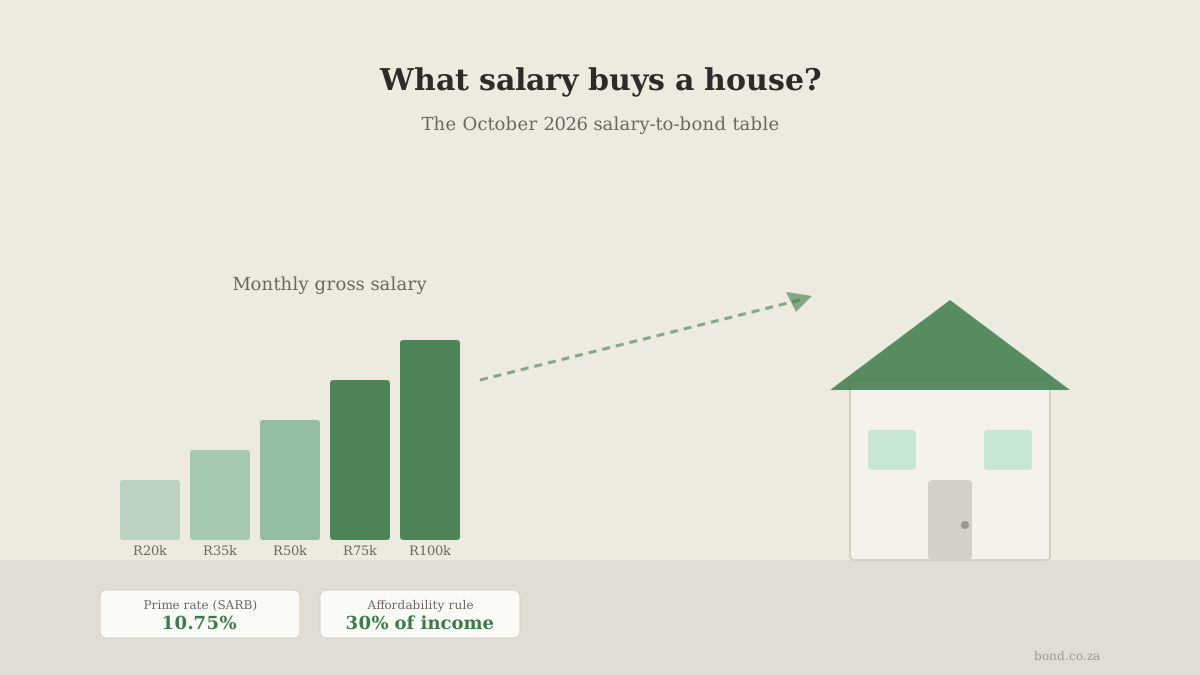
There is no single minimum salary — banks size your bond off the repayment your income can carry. The standard guideline keeps the monthly instalment at or below 30% of gross income. At 10.75% prime (effective 25 September 2026) over a 20-year term, that works out to:
- Earn R 20 000 a month → a bond of about R 591 000
- Earn R 30 000 a month → a bond of about R 886 500
- Earn R 50 000 a month → a bond of about R 1 477 499
- Earn R 75 000 a month → a bond of about R 2 216 249
- Earn R 100 000 a month → a bond of about R 2 954 998
| Gross monthly income | Max instalment (30%) | Estimated max bond |
|---|---|---|
| R 20 000 | R 6 000 | ≈R 591 000 |
| R 30 000 | R 9 000 | ≈R 886 500 |
| R 50 000 | R 15 000 | ≈R 1 477 499 |
| R 75 000 | R 22 500 | ≈R 2 216 249 |
| R 100 000 | R 30 000 | ≈R 2 954 998 |
These are ceilings, not targets: most buyers qualify for less once the bank prices their rate and checks their expenses. For the full income-to-bond breakdown, including joint incomes and existing-debt scenarios, see our minimum salary for a home loan guide.
How did September's rate hike change what you can borrow?
The SARB raised the repo rate to 7.25% on 23 September 2026, taking prime from 10.50% to 10.75% with effect from 25 September 2026. Because affordability is calculated off the instalment, a higher prime shrinks the bond the same salary can carry — the 30% instalment buys less house:
| Gross monthly income | At 10.50% (before) | At 10.75% (now) | Buying power change |
|---|---|---|---|
| R 20 000 | ≈R 600 974 | ≈R 591 000 | -R 9 974 |
| R 30 000 | ≈R 901 460 | ≈R 886 500 | -R 14 961 |
| R 50 000 | ≈R 1 502 434 | ≈R 1 477 499 | -R 24 935 |
| R 75 000 | ≈R 2 253 651 | ≈R 2 216 249 | -R 37 402 |
| R 100 000 | ≈R 3 004 868 | ≈R 2 954 998 | -R 49 870 |
The next MPC decision falls on 19 November 2026. If the committee holds, buying power stays where this table puts it; another 25bp hike would compress it further.
What salary do you need for a R1 million house?
With a 10% deposit you finance R 900 000, which costs about R 9 137 a month at 10.75% prime over 20 years — a gross income of roughly R 30 457 under the 30% rule. With a 100% bond you finance the full R1 million: about R 10 152 a month and roughly R 33 841 of income. And remember that transfer duty, bond registration costs and moving costs sit on top of the purchase price — they are not financed by the bond.
Does a deposit reduce the salary you need?
Yes — a deposit shrinks the loan and usually earns a better rate. Home-loan offers across the major banks typically land between prime minus 1.0% and prime plus 2.0%, depending on credit profile, deposit and loan-to-value. The average concession across originator-submitted bonds was 0.67% below prime per ooba Home Loans (as at 3 October 2026). On a R 900 000 bond, a rate that much lower trims the instalment by roughly R 404 a month, which lowers the income needed to qualify.
What else do banks check besides your salary?
Salary is the first filter, not the decision. Under the National Credit Act, banks run a full affordability assessment: your credit record and score, existing debt repayments, monthly living expenses and net disposable income — a high salary with high debt can qualify for less than the 30% table suggests. They also value the property itself, because the loan is secured against it. The rate you are offered sits anywhere in the prime minus 1.0% to prime plus 2.0% band, which moves the instalment and therefore the income required. None of these figures constitute pre-approval or a guaranteed rate.
How do you check what you qualify for?
Run your own numbers with the home loan affordability calculator and the bond repayment calculator — enter your income and the calculator applies the same 30% affordability rule at today's prime. When you are ready to buy, get pre-approved: pre-approval certificates are typically valid for 90 days, which covers the 19 November 2026 decision. A bond originator submits your application to multiple banks at once, which is how the average 0.67% below-prime concession is achieved. Answer the two questions below for a personalised estimate.
(Published 23 October 2026. Prime and repo verified against the SARB September 2026 MPC statement. Rate concession per ooba Home Loans, checked 3 October 2026. Bond-size examples: 20-year term at prime with no margin, instalment capped at 30% of gross income — your actual rate and approval may differ.)