How much deposit do you need to buy a house in South Africa?
There is no legal minimum deposit in South Africa — but the standard benchmark banks work from is 10% of the purchase price, per ooba Home Loans. On typical price bands, 10% looks like:
- R 500 000 home → a deposit of R 50 000
- R 1 000 000 home → a deposit of R 100 000
- R 1 500 000 home → a deposit of R 150 000
- R 2 000 000 home → a deposit of R 200 000
In practice the deposit a specific buyer is asked for depends on credit record, income stability, existing debt and the property's value. Strong profiles are granted bonds with no deposit at all; weaker ones may be asked for more. For the full picture — including how deposits interact with transfer costs — see our home loan deposit guide.
Can you buy a house with no deposit?
Yes — 100% home loans exist, and banks grant them to buyers with strong credit records and stable income, first-time buyers included. The trade-offs are real: you finance a bigger bond at today's 10.75% prime, usually at a higher rate than a deposit-backed loan would earn, and you start ownership with no equity buffer if prices dip. You also still need cash for what the bond does not cover — transfer duty, bond registration costs and moving expenses. Our 100% home loan guide covers who qualifies and what it costs.
What does a deposit actually save you at 10.75% prime?
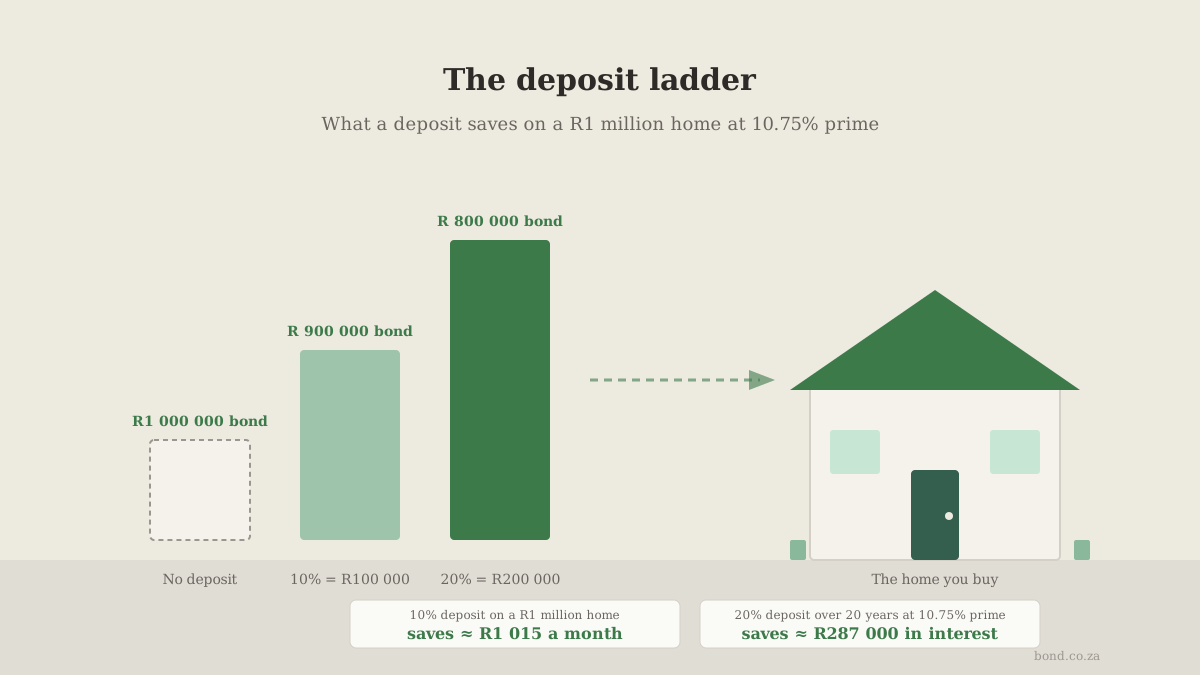
A deposit works twice: it shrinks the bond you borrow, and the smaller, lower-risk bond usually earns a better rate. At 10.75% prime (effective 25 September 2026) over a 20-year term, here is the same R 1 000 000 house at three deposit levels:
| Deposit | Bond amount | Monthly repayment | Total interest over term |
|---|---|---|---|
| No deposit | R 1 000 000 | R 10 152 | R 1 436 549 |
| 10% deposit | R 900 000 | R 9 137 | R 1 292 895 |
| 20% deposit | R 800 000 | R 8 122 | R 1 149 240 |
Read the ladder from the bottom up: moving from no deposit to 10% saves about R 1 015 a month, and to 20% about R 2 030 a month — roughly R 287 310 in interest over the 20 years. Run your own price through the bond repayment calculator.
Where does the deposit go when you buy a house?
Not to the seller. Once your offer is accepted, the deposit is paid into the conveyancing attorney's trust account — a regulated, audited account — where it sits until the transfer registers at the Deeds Office. It is then applied to the purchase price. Never pay a deposit into a personal bank account, and treat any instruction to do so as a red flag. Remember the deposit is not your only cash requirement: transfer duty and bond registration costs come on top, which our transfer and bond costs guide breaks down.
How can you get help with a deposit?
Three routes close the gap. First, First Home Finance (FLISP): a government subsidy for qualifying first-time buyers earning within the income band, paid towards the purchase — our FLISP guide explains eligibility and amounts. Second, a gifted deposit from family is accepted by banks when documented properly — see the gifted deposit guide. Third, a 100% bond removes the deposit requirement entirely for buyers who qualify — at the cost of a bigger loan.
How do you check what you qualify for?
Start with the home loan affordability calculator to size the bond your income carries, then test deposit scenarios in the bond repayment calculator at today's prime. When you are ready to buy, get pre-approved: a pre-approval certificate tells you the price band and deposit a bank will actually back you for, and is typically valid for 90 days — which covers the 19 November 2026 decision. Answer the two questions below for a personalised estimate.
(Published 24 October 2026. Deposit benchmark per ooba Home Loans, checked 24 October 2026. Prime and repo verified against the SARB September 2026 MPC statement. Repayment and interest figures: 20-year term at prime with no margin, computed by bond.co.za — your actual rate and approval may differ.)