What does it cost to buy a R1.5 million house in November 2026?
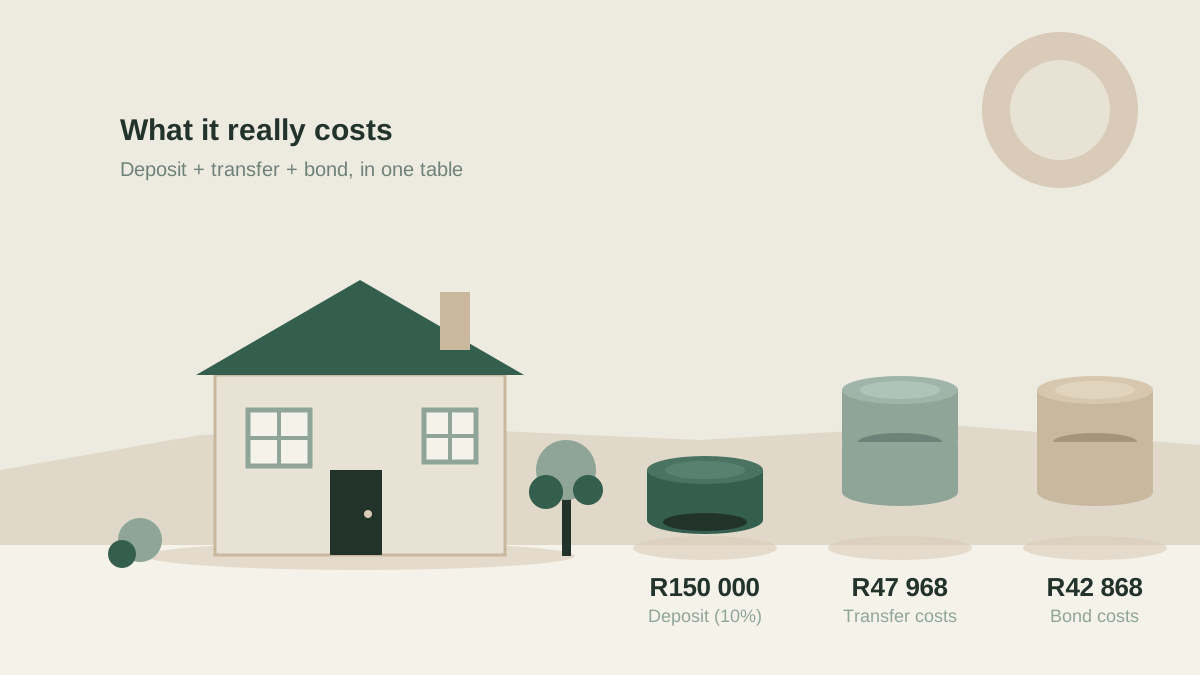
To buy a R1.5 million house in South Africa in November 2026 you need about R 240 836 in cash and, once registered, about R 13 706 a month on the bond. The cash divides into a R 150 000 deposit (10% of the price, leaving a R 1 350 000 home loan) and roughly R 90 836 in once-off costs — transfer duty, conveyancing fees, Deeds Office fees and the bank's initiation fee. That is about 6.1% of the purchase price before the deposit, or about 16.1% of the price all in. Here is the full breakdown, every line computed by bond.co.za from published tariffs:
| Cost (R1.5m purchase, 10% deposit) | Amount |
|---|---|
| Deposit (10% — paid to the seller via the transfer attorney) | R 150 000 |
| Transfer duty (SARS, effective 1 April 2026) | R 8 700 |
| Transfer attorney fee, incl. VAT (LSSA guideline) | R 37 530 |
| Deeds Office transfer registration fee | R 1 738 |
| Bond attorney fee, incl. VAT (LSSA guideline) | R 35 092 |
| Deeds Office bond registration fee | R 1 738 |
| Bank initiation fee, incl. VAT (NCA maximum) | R 6 038 |
| Once-off costs total (excluding deposit) | R 90 836 (6.1%) |
| Total cash needed (deposit + costs) | R 240 836 (16.1%) |
Notice what the table says about where the money actually goes: the attorney fees, Deeds Office fees and initiation fee together come to about R 82 136 — roughly nine times the transfer duty itself. Duty gets the headlines because it is a tax, but the professional fees are where most of the cash goes. Check your own price point in the transfer cost calculator or the combined bond and transfer cost calculator.
How much is the deposit on a R1.5 million house?
At the standard 10%, the deposit on a R1.5 million house is R 150 000. A deposit is not a legal requirement — banks can grant 100% bonds — but planning around 10% is the safer default: it lowers the loan to R 1 350 000, keeps your rate offer out of the expensive end of the bank's band, and improves your approval odds. With no deposit the bond would be the full R 1 500 000, costing about R 15 228 a month at 10.75% prime — roughly R 1 523 more every month than the 10%-deposit version, by our calculation. For deposit sizes across other price bands, see our October 2026 deposit table.
How much is transfer duty on a R1.5 million house?
Transfer duty on a R1.5 million house is R 8 700. SARS charges no duty on the first R1.21 million of a property's value and 3% on the value above that, so the calculation is 3% × (R1.5m − R1.21m) = R 8 700 (table effective 1 April 2026, unchanged for 2026/27). Below R1.21 million no duty is payable at all — which is why buyers under that threshold often underestimate the remaining costs. Two caveats: duty is charged on the higher of price or market value, and sales from registered developers that include VAT carry no transfer duty.
What are the transfer and bond registration costs?
Two separate attorney mandates run alongside the duty: the transfer attorney (appointed by the seller) who registers the property into your name, and the bond attorney (appointed by the bank) who registers the bank's mortgage bond. Each charges on the LSSA guideline tariff, quoted excluding VAT with 15% added, and each lodges at the Deeds Office for a fixed tariff fee:
| Transfer side (R1.5m property) | Amount |
|---|---|
| Transfer duty | R 8 700 |
| Transfer attorney fee (incl. 15% VAT) | R 37 530 |
| Deeds Office transfer fee | R 1 738 |
| Transfer side total | R 47 968 |
| Bond side (R1.35m home loan) | Amount |
|---|---|
| Bond attorney fee (incl. 15% VAT) | R 35 092 |
| Deeds Office bond registration fee | R 1 738 |
| Bank initiation fee (NCA maximum, incl. VAT) | R 6 038 |
| Bond side total | R 42 868 |
Attorney fees are negotiable in practice — the guideline is a tariff, not a law — and some banks run promotions that cover part of the bond registration costs. For the full mechanics, see our guide to transfer and bond costs.
What is the bank initiation fee?
The bank initiation fee is a once-off charge for setting up the home loan. The National Credit Act caps it at R 6 038 including VAT for individuals (R1 100 plus 10% of the principal above R10 000, capped at R5 250 excluding VAT), and the major banks all charge the maximum — so this is one cost that does not vary between Standard Bank, FNB, Nedbank and Absa. It can be paid upfront or capitalised into the bond: capitalised, it becomes about R 61 a month and roughly R 14 711 over the 20-year term, by our calculation — paying it upfront saves the interest.
What is the monthly repayment on a R1.5 million house?
With a 10% deposit, the R 1 350 000 bond costs about R 13 706 a month over 20 years at 10.75% prime (SARB, effective 25 September 2026), computed by bond.co.za with the standard annuity formula. But 10.75% is the midpoint of the pricing conversation, not a quote — offers across the major-bank panels typically land between prime -1% and prime +2% depending on your credit profile and loan-to-value:
| Scenario (R 1 350 000 bond, 20 years) | Rate | Monthly repayment |
|---|---|---|
| Strong credit profile with a 10% deposit | 9.75% | R 12 805 |
| Prime (the bank’s standard quoted rate) | 10.75% | R 13 706 |
| Weaker or thin credit profile, or a 100% bond | 12.75% | R 15 576 |
The spread between the best and worst row is about R 2 771 a month on the same loan — a real cost, even though it never appears on any tariff. The average concession banks give across the bonds originator ooba registers is about 0.67% below prime, which is why submitting to multiple banks matters. Model your own scenario in the bond repayment calculator.
How much salary do you need to buy a R1.5 million house?
Under the banks' rule of thumb — instalment up to 30% of gross monthly income — a R 13 706 instalment implies roughly R 45 685 gross monthly income (computed by bond.co.za: R 13 706 ÷ 0.30). Affordability assessment counts your other debts too: car finance, student loans and credit cards all shrink the share of your income the bond can claim. Check what a bank would see with the home loan affordability calculator, and if you are a first-time buyer within the income bands, check whether you qualify for a FLISP subsidy towards the purchase.
How can you reduce the cash you need?
Three levers move the R 90 836 figure. First, price: buy at R1.2 million instead of R1.5 million and transfer duty falls to zero — the duty-free threshold is the single biggest cliff in the cost table. Second, negotiate the fees: attorney fees are guideline tariffs, not fixed prices, and quotations vary. Third, borrow the structure smartly: capitalising the initiation fee cuts your day-one cash by R 6 038at the cost of interest over the term, and a bond originator submitting you to all the major banks costs you nothing while improving the rate — and every rand of rate is worth far more than any once-off fee. No bank guarantees approval or a rate; both depend on your profile on the day.
(Last updated 9 November 2026. Duty table: SARS, effective 1 April 2026; attorney fees: LSSA guideline, effective 1 July 2026, excl. VAT with 15% added; Deeds Office fees: Gazette No. 54225, effective 1 April 2026; initiation fee: NCA Reg 42(2), re-verified 15 October 2026. Prime rate 10.75% verified against the SARB September 2026 MPC statement. Repayment examples: 20-year term at the stated rate, no margin — your actual rate may be prime plus or minus a margin.)